The cost of building a tiny home in the Texas Hill Country is often much higher than the price of the home itself. Most first-time builders budget for the structure but underestimate the land development costs that make a property livable.
A tiny home can be an affordable path to property ownership, but the home itself is only one part of the budget. Land, septic, utilities, water, permits, driveway access, and site preparation can add tens of thousands of dollars to the total project cost. On some rural properties, those expenses rival or even exceed the price of the home.
For homeowners building in the Texas Hill Country, those surrounding costs carry extra weight. Limestone bedrock, thin soil, and steep terrain can turn routine site work into the most expensive line on the budget. This guide walks through each major cost category so you can build a realistic number before you buy land or sign a builder contract.
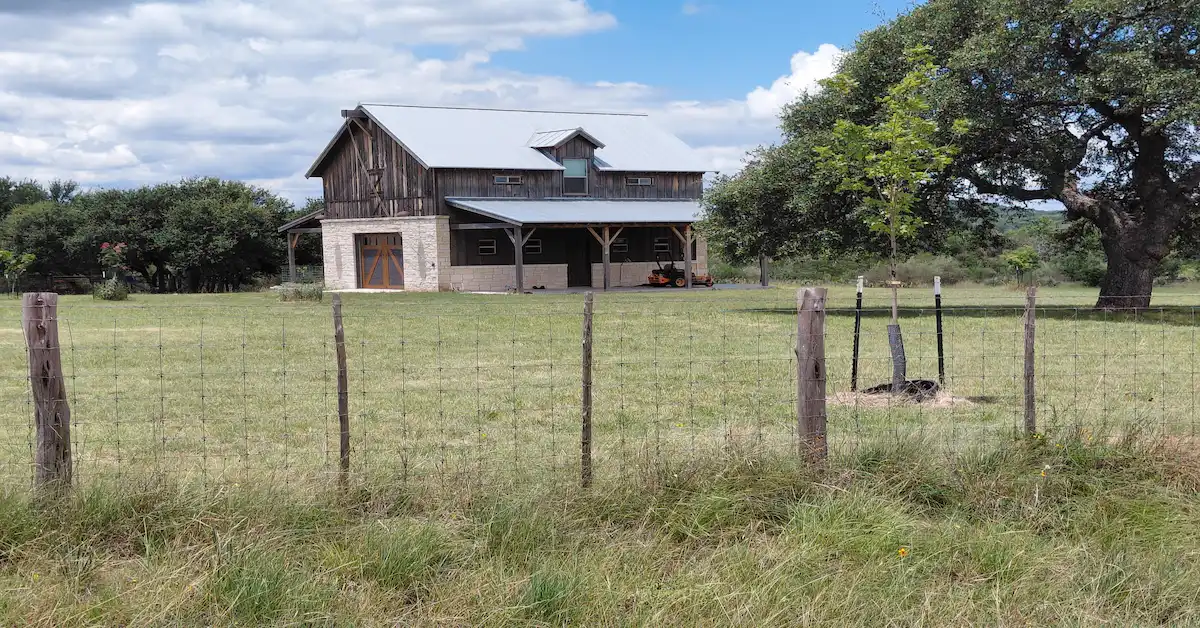
What is the Cost of Building a Tiny Home in Texas?
A professionally built tiny home in Texas generally falls between $30,000 and $150,000 for the structure alone, with national cost guides placing most builds at $150 to $450 per square foot, depending on size, finishes, and whether the home sits on wheels or a foundation. Yes, you can purchase a shed at your local home improvement store for less if you choose.
Prefabricated and factory-built models occupy the lower end. Entry-level prefab cabins can start around $20,000 for a basic shell, while finished prefab tiny homes typically run $150 to $250 per square foot. These prices usually cover the home itself — not delivery, hookups, or the work needed to make the lot ready.
Custom-built tiny homes cost more because of design, labor, and higher-end materials, generally landing between $50,000 and $140,000, or roughly $250 to $450 per square foot. In the Dallas–Fort Worth market, builders describe three rough tiers: entry-level builds around $30,000 to $60,000, mid-range builds from $60,000 to $100,000, and premium builds of $100,000 and up.
A tiny home on wheels (THOW) is its own category. Professionally built models in 2026 commonly run $70,000 to $150,000, with most buyers paying $80,000 to $130,000. A tiny home built on a permanent foundation behaves more like a small conventional house, and is often financed and permitted differently — a distinction covered in tiny homes on foundations.
Most builder quotes describe the structure and little else. The number that matters for your budget is the total project cost, not the price in the brochure.
The Costs Most Tiny Home Buyers Forget to Budget For
The gap between a builder’s quote and a buyer’s final spend almost always comes from the same handful of items. Site preparation, utility connections, a wastewater system, driveway access, and permitting are rarely bundled into the price of the home, yet a tiny home cannot be occupied without them. This is assuming your tiny home isn’t an RV alternative on wheels.
On a finished lot inside an established rural subdivision — one with a road, a water tap, and an electric meter already at the property line — these added costs can be modest. On raw land, the same items can rival or exceed the price of the home itself. Utility hookups alone can reach $25,000 depending on land conditions.
The pattern that catches buyers off guard is sequencing. A builder delivers a finished structure, and only then does the owner discover the lot still needs a septic permit, a graded pad, a gravel drive, and a power line extension before anyone can move in. Each section below breaks down one of those categories. What appears to be “common sense” to many invariably is a surprise to others. Let’s consider each beginning with the septic system.
Septic System Costs for Tiny Homes in Texas
Start with the regulation. A tiny home in Texas that is not connected to a municipal sewer must dispose of wastewater through an approved on-site sewage facility (OSSF), regulated by the Texas Commission on Environmental Quality (TCEQ) under 30 TAC Chapter 285. Small square footage does not exempt a dwelling from this requirement.
Before any system is permitted, a licensed site evaluator or professional engineer must perform a site evaluation on the tract to document soil and site conditions. This step determines what type of system your property can legally support, and it is required on every tract where an OSSF will be installed. Site evaluations typically cost $300 to $800. Our companion guide explains what a site evaluation involves and why Texas relies on it rather than a traditional perc test.
Cost comes next, and it separates cleanly from the regulation. Conventional gravity systems in Texas generally run $6,300 to $10,000 installed, while aerobic treatment systems run $10,000 to $20,000. In some locations, potentially up to $30,000. The spread matters because soil conditions, lot size, and location often dictate which system you are allowed to use rather than which you would prefer.
Tank size is a frequent point of confusion. Even a very small home needs an appropriately sized tank: Our HCSG’s research found that tiny homes under 1,500 square feet generally require a minimum 750-gallon tank under the Chapter 285 sizing tables. A smaller home does not automatically mean a smaller or cheaper septic system, because the system is sized for daily wastewater flow and minimum standards, not floor area alone.
Permits and engineering typically add $1,500 to $5,000 on top of the system itself. Aerobic systems also carry an ongoing obligation — Texas requires a maintenance contract with periodic inspections, generally costing $200 to $600 per year. Note: some counties have adopted more stringent rules. Contact your County Authorized Agent for specific guidelines.
Land and Site Preparation Costs
Raw land rarely arrives build-ready. Clearing vegetation, grading a level pad, cutting a driveway, and trenching for utilities are separate jobs, and each one adds to the budget before the home ever arrives.
Land clearing in Texas averages around $4,000 per acre, though lightly wooded lots may run $733 to $2,333 per acre and heavily forested parcels $3,395 to $6,155 per acre. Grading to create a stable, properly drained building pad generally costs $1 to $3 per square foot, with sloped sites pushing toward the higher end.
Access is its own line item. A gravel driveway commonly runs $1,500 to $4,000 depending on length and thickness, and the grading or excavation work to prepare it can add $1,000 to $2,500. Rural lots set far back from the road require more gravel, more grading, and sometimes culverts or drainage work, which can run $500 to $2,000.
These figures assume cooperative terrain. On difficult sites, conditions can raise labor costs 20% to 50% — which is exactly where many Hill Country lots land.
Utility Connection Costs
Electricity. If a power line already runs near your property, a basic connection through a rural cooperative may cost a few thousand dollars. One Hill Country–area cooperative estimates roughly $3,000 to $4,300 for a short single-phase connection and $5,400 to $7,200 for a connection requiring a few hundred feet of line and several poles. Many cooperatives cover a set distance or contribute a fixed amount (often up to around $5,000) and bill the property owner for construction beyond that through a nonrefundable contribution-in-aid-of-construction. A long line extension across a large rural parcel can therefore cost considerably more.
Water. Properties without access to a rural water line need a private well. In the Texas Hill Country, a complete residential well system commonly runs $10,000 to $25,000, reflecting the depth and difficulty of drilling through limestone. Statewide, the average residential well is about 225 feet deep and runs near $8,550, with drilling priced around $25 to $58 per foot — but limestone formations push Hill Country per-foot rates to $35 to $65, and total depth can be unpredictable. Texas requires a licensed water well driller for the work.
Where a rural water supply line is available, connecting to it is typically far cheaper than drilling, though tap and meter fees vary by provider. Rural water tap and connection fees vary widely among the water supply corporations serving the 12-county area; confirm the exact figure with the specific provider for the property in question.
Propane. Many tiny homes rely on propane for heat, cooking, or hot water. Installing a residential propane tank generally costs $2,500 to $4,000.
Why Texas Hill Country Properties Often Cost More to Develop
The cost ranges above widen on Hill Country land for reasons rooted in geology. The points below describe common regional realities, not statewide requirements.
Limestone bedrock sits close to the surface across much of the region. The same rock that makes the views dramatic also makes trenching, drilling, and excavation harder and slower. Septic installers may add $1,500 to $4,500 for excavation in rocky terrain, and rock trenching for drain fields can add $2,000 to $5,000. Central Texas and Hill Country septic costs commonly run 15% to 20% above metro Texas for these reasons.
Thin soil over rock also affects which septic system is even permitted. Where soil cannot absorb effluent within the range TCEQ allows, where a lot is small, or where a property sits over the Edwards Aquifer recharge zone, an aerobic system may be required rather than a cheaper conventional one — moving the septic line from roughly $7,000 toward $15,000 or more.
Wells go deeper and cost more here than in almost any other part of the state, and steep, wooded terrain raises clearing, grading, and driveway costs. A property with a long, sloped approach can turn a routine gravel drive into a significant earthwork project.
Sample Tiny Home Budget Scenarios
The scenarios below are illustrative examples, not quotes or guarantees. They combine the ranges already discussed to show how total project cost shifts with site conditions. Actual numbers depend on the specific lot, builder, and county.
Scenario A — Tiny home in an established rural subdivision. The lot already has a road, an electric meter at the line, and a community water tap. The owner buys a finished prefab tiny home, connects to existing utilities, and installs a conventional septic system on suitable soil. The structure, a modest septic system, a short driveway, and existing utility hookups keep the surrounding costs relatively contained.
Scenario B — Raw land requiring infrastructure. The owner buys an undeveloped parcel with no utilities at the property. The budget now has to absorb land clearing, grading, a gravel driveway, a power line extension, a septic system, and either a well or a water connection. These site and infrastructure costs can collectively approach or exceed the price of the tiny home itself.
Scenario C — Hill Country property with septic and well. The owner buys scenic limestone acreage. The site needs an aerobic septic system because of thin soil, a deep limestone well, a long graded driveway, a power line extension, and a propane tank. Here the development costs frequently become the largest part of the total project — often more than the home.
Building a Realistic Budget Before You Buy Land
The price of the home is the easiest number to find and the least likely to wreck a budget. Land development — septic, water, electricity, clearing, grading, and access — is where tiny home projects in Texas quietly double.
The most useful move a buyer can make is to order a site evaluation early, ideally before closing on land, or at minimum before committing to a system or a builder. Because soil and rock conditions dictate which septic system you can install and how deep a well must go, the site evaluation converts the largest unknowns into real numbers you can budget against.
Build your budget from the lot up, not the home down. Price the structure, then add site preparation, septic, utilities, and permits as their own lines, and confirm each one against your specific county and providers before you buy. The buyer who budgets for the whole project — not just the home — is the one who breaks ground without an expensive surprise.
CONCLUSION
The price of the tiny home itself is usually the easiest number to find. The harder numbers are tied to the land: septic, utilities, water, driveway access, permits, and site preparation.
In the Texas Hill Country, those costs deserve special attention because limestone, topography, and rural infrastructure often affect what can be built and what it will cost to develop. Two properties with the same purchase price can have dramatically different development costs.
Before buying land, take the time to understand septic feasibility, utility availability, and site preparation requirements. Building a realistic budget before you close on a property is often the difference between a smooth project and an expensive surprise. The buyers who evaluate the land first are usually the ones who stay closest to their budget once construction begins.
Related Readings:
Tiny Homes on Foundation in Texas: Septic, Permits, and Land Explained – Hill Country Septic Guide
What Is a Perc Test? Why Texas Uses Site Evaluations Instead
Septic System Installation Cost in Texas — What Hill Country Homeowners Actually Pay
Limestone Soil Septic Systems in Texas — 5 Critical Things Hill Country Homeowners Must Know