Tiny homes on foundation in Texas appeal to buyers and builders who want the permanence of a traditional home without the size or cost of conventional construction. What many people discover (I was one of them), however, is that placing a tiny home on a permanent foundation often introduces new challenges rather than eliminating them. Septic requirements, permits, setbacks, and land limitations can all affect whether a project moves forward as planned. Understanding those requirements before purchasing land or ordering a structure can help avoid costly surprises later.
This guide covers what buyers, builders, and property owners need to understand before committing to a foundation tiny home in the Texas Hill Country.
What Makes a Tiny Home “On Foundation” in Texas?
In Texas, the distinction between a tiny home on wheels (THOW) and a tiny home on foundation isn’t just a matter of aesthetics or preference — it’s a legal and regulatory dividing line.
A tiny home on wheels (THOW) is classified as a recreational vehicle in most Texas jurisdictions. It can be moved, relocated, and in some cases parked on property without triggering the full weight of state building and septic regulations.
A tiny home on foundation is a different matter entirely.
Once a structure is permanently affixed to the ground — whether on a concrete slab, pier and beam system, or permanent piers — it is treated as a residential dwelling under Texas law. That classification triggers:
- Building permit requirements at the county or municipal level
- TCEQ OSSF regulations for on-site sewage facilities
- Setback requirements under TAC Title 30, Chapter 285
- Site evaluation requirements including soil testing and site planning
The foundation is the trigger. Everything flows from that decision.
Why Foundation Tiny Homes Face Different Rules Than THOWs
The regulatory gap between THOWs and foundation tiny homes is wide — and it catches buyers off guard more often than most other issues in this space.
A THOW owner can, in many circumstances, connect to an existing septic system, use an RV hookup, or rely on alternative waste management arrangements, depending on local ordinances. The flexibility exists because the structure itself is not classified as permanent.
Tiny homes on foundation in Texas trigger full Texas Commission on Environmental Quality (TCEQ) OSSF requirements the moment a permanent foundation is established. There is no middle ground. Once the structure is permanent, the property must have a compliant on-site sewage facility — designed, permitted, and installed by a TCEQ-licensed professional — before occupancy is legal.
This distinction matters enormously for land buyers. A parcel that works perfectly for a THOW may not support a foundation tiny home at all — not because of the structure, but because of what the land can and cannot accommodate on the septic side.
Much of the confusion comes from the fact that Texas treats tiny homes on wheels and tiny homes on foundations differently. Buyers often hear that “tiny homes are legal in Texas” without realizing that local regulations, deed restrictions, and septic requirements can still prevent a foundation installation on a specific property.
Can You Legally Place Tiny Homes on Foundation in Texas?
The short answer is yes — but with conditions that vary by county and depend heavily on the land itself.
Texas does not have a statewide building code for residential construction outside of municipalities, which means county rules vary significantly across the Hill Country. What Kerr County allows may differ from what Gillespie or Kendall County requires. Some counties have adopted amendments to the International Residential Code. Others operate under minimal county-level oversight but full TCEQ authority on the septic side.
Before placing a tiny home on foundation in Texas, you need to verify:
- Deed restrictions — many rural parcels carry restrictions that prohibit structures under a minimum square footage
- County regulations — contact the county judge’s office or county building department to confirm what permits are required
- HOA or subdivision rules — if the property sits inside a subdivision, additional restrictions may apply
- Minimum square footage requirements — some Texas counties and municipalities have minimum size requirements for permanent dwellings
The septic permit is non-negotiable regardless of county. TCEQ jurisdiction over on-site sewage facilities applies statewide. No county exemption exists for that requirement.
Septic Requirements for Tiny Homes on Foundation in Texas
This is where the foundation decision becomes a land decision.
Many buyers approach a foundation tiny home purchase the same way they’d approach buying a manufactured home — find the land, order the structure, arrange delivery. That sequence creates serious problems when the land hasn’t been evaluated for septic suitability first.
Why foundation tiny homes can’t connect to city sewer in rural Texas
The vast majority of Hill Country properties are not served by municipal sewer systems. Rural acreage in Kerr, Gillespie, Blanco, Llano, and surrounding counties relies entirely on on-site sewage facilities. There is no city sewer connection available. The land must support a compliant septic system or the structure cannot be legally occupied.
Why land suitability must be confirmed before you commit
A site evaluation — which includes a soil analysis and site plan — must be completed before a septic permit can be issued. That evaluation determines whether the soil can support a conventional drain field, whether an aerobic system is required, and whether the lot has sufficient usable space for both the structure and the septic components. Purchasing land before that evaluation is complete is one of the most expensive mistakes a foundation tiny home buyer can make.
Why your foundation footprint and drain field must be planned together
The drain field cannot be placed under a structure, driveway, or parking area. It cannot be located within required setback distances from property lines, water wells, or surface water. On a small rural lot, the relationship between where the foundation sits and where the drain field can legally go is not flexible. Tiny homes on foundation in Texas require a site plan that accounts for both the structure and the septic system before either is installed.
Why some lots can support a structure but not a compliant septic system
This is the scenario that surprises buyers most. A lot may have excellent road access, beautiful views, and no deed restrictions — and still be unable to support a legal foundation tiny home because the soil cannot accommodate a compliant drain field. Shallow rock, poor percolation rates, and proximity to water features can all eliminate septic options regardless of how suitable the land appears on the surface.
Why Hill Country Land Can Create Unexpected Challenges
The Texas Hill Country is one of the most distinctive and challenging landscapes in the state for septic system design — and foundation tiny home buyers need to understand why before they fall in love with a piece of land.
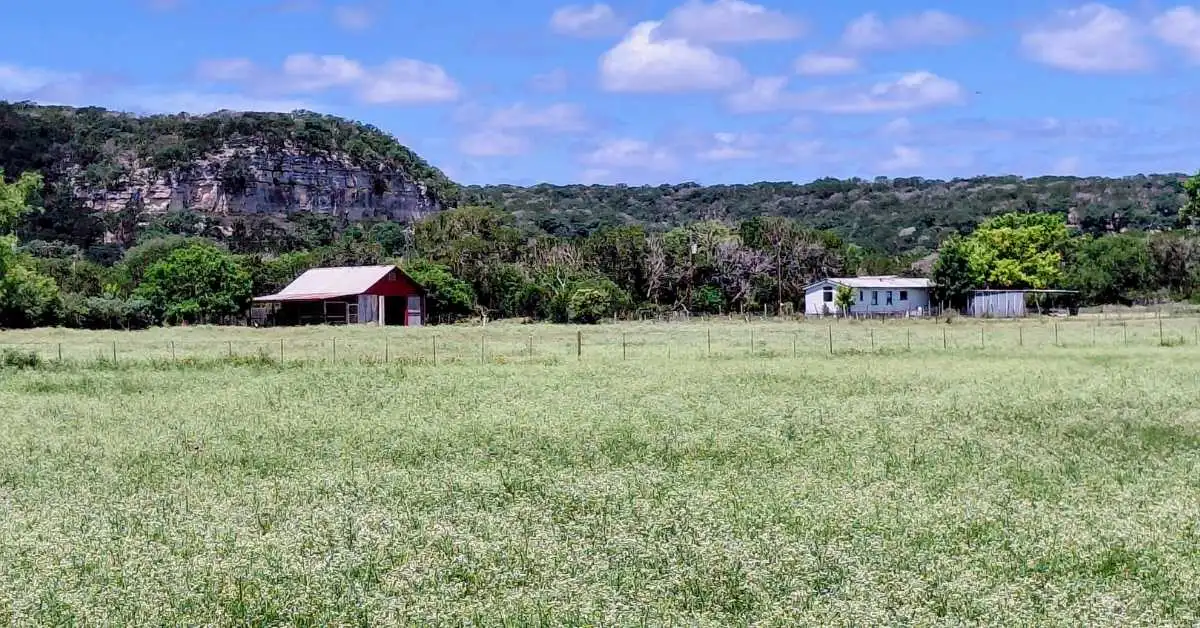
The region sits on the Edwards Plateau, a vast formation of limestone bedrock that lies close to — and in many places directly at — the surface. Karst terrain, characterized by thin soils, fractured rock, and sinkholes, dominates much of the Hill Country’s geology.
That geology creates several septic challenges specific to this region:
Shallow soil depth. TAC Chapter 285 requires minimum soil depth for conventional drain field installation. In much of the Hill Country, native soil depth above limestone bedrock is measured in inches, not feet. Sites that appear suitable from the surface frequently fail site evaluation because of insufficient soil depth.
Poor percolation in clay-heavy areas. Where limestone gives way to clay soils — common in parts of Bandera, Medina, and Kimble counties — percolation rates slow dramatically. Slow perc rates require larger drain fields, which require more usable land.
Karst sensitivity and groundwater protection. The Edwards Aquifer and its contributing zone underlie significant portions of the Hill Country. TCEQ regulations in these areas are stricter, and aerobic treatment systems are frequently required where conventional systems would otherwise be permitted.
Slope and drainage constraints. Hill Country terrain is rarely flat. Sloped lots create runoff and setback complications that further limit where a drain field can be legally placed.
Existing Trees and Site Layout Constraints. Many buyers choose Hill Country property because of its mature live oaks, scenic views, and natural character. What often comes as a surprise is that foundations, driveways, septic drain fields, and required setbacks all compete for the same limited buildable space. Preserving desirable trees while maintaining adequate room for both a structure and a compliant septic system can become a significant design challenge, particularly on smaller lots. A property may have enough acreage for a tiny home on foundation, yet still require careful site planning to balance tree preservation, access, and septic placement.
The practical result: a site evaluation is not a formality in the Hill Country. It is a critical due diligence step that should happen before any land purchase involving a foundation structure.
Common Mistakes Tiny Home Owners Make Before Building
These are the decisions that cost buyers time, money, and in some cases the property itself.
Buying land before verifying septic feasibility. The most common and most expensive mistake. A site evaluation costs a few hundred dollars. Purchasing land that cannot support a compliant septic system can cost tens of thousands.
Assuming a foundation guarantees permit approval. A permanent foundation triggers the permit requirement — it does not guarantee approval. The land still has to pass site evaluation, meet setback requirements, and satisfy county regulations before a permit is issued.
Underestimating septic costs. In the Hill Country, conventional septic systems are frequently not an option. Aerobic treatment systems — required on sites where conventional systems can’t be permitted — cost significantly more to install and carry ongoing maintenance contract requirements under Texas law. Buyers who budget for a conventional system and discover they need aerobic are often caught off guard.
Overlooking setback requirements. TAC Chapter 285 establishes minimum setback distances between septic components and structures, property lines, water wells, and surface water. On small rural lots, those setbacks can eliminate viable drain field locations entirely.
Skipping the deed restriction check. Many Hill Country parcels — particularly those in older subdivisions or on land carved from larger ranches — carry deed restrictions that prohibit structures under a minimum square footage. A 400-square-foot foundation tiny home may violate restrictions that have been attached to the land for decades.
Ordering the Tiny Home Before Verifying the Site. Some buyers place deposits on a tiny home before confirming septic feasibility, setbacks, or access requirements. By the time site limitations are discovered, the structure is already under contract.
Your Pre-Build Checklist: Foundation Tiny Homes in the Texas Hill Country
Before committing to land or a structure, work through this checklist in order.
Verify local regulations. Contact the county judge’s office or county building department. Confirm what permits are required for a permanent residential structure and whether the county has adopted a building code.
Check deed restrictions. Obtain a copy of any deed restrictions attached to the property. Confirm there is no minimum square footage requirement or prohibition on alternative dwelling types.
Confirm septic feasibility. Engage a TCEQ-licensed Authorized Agent or OSSF professional to conduct a preliminary site evaluation before purchasing the land. Do not skip this step.
Evaluate soil conditions. The site evaluation will include soil analysis. Understand what system type the soil can support — conventional, aerobic, or alternative — and what that means for your budget.
Check setbacks. Confirm that the lot has sufficient space to accommodate both the foundation footprint and all required septic setbacks simultaneously. A lot that works for one may not work for both.
Budget for permits. Septic permits, site evaluations, and county building permits all carry fees. Factor those costs into your total project budget before signing anything.
Contact your county’s Authorized Agent. Each of the 12 Hill Country counties has a TCEQ-designated Authorized Agent who oversees OSSF permitting locally. That contact is your first call on the septic side. Find all 12 on the County Contacts page.
What to Expect: Permits, Septic Timelines, and Costs
For many buyers, septic costs become the single largest site-development expense associated with a foundation tiny home. Understanding the land-development timeline helps buyers plan realistically.
Site evaluation: Typically completed within one to three weeks of engaging a licensed professional. Results determine system type and site plan requirements.
Septic permit application: Submitted to the county Authorized Agent following site evaluation. Processing times vary by county — plan for two to six weeks in most Hill Country counties.
Septic system installation: Once permitted, installation of a conventional system typically takes one to three days. Aerobic systems take longer due to the complexity of the equipment and inspection requirements.
County building permit: Timeline varies significantly by county. Some Hill Country counties process residential permits quickly. Others have limited staff and longer review periods. Contact your specific county early.
Cost ranges:
- Site evaluation: $300 – $600
- Conventional septic system: $8,000 – $15,000
- Aerobic septic system: $15,000 – $25,000+
- County building permit fees: $200 – $1,500 depending on county and structure size
These figures are estimates based on current Hill Country market conditions. Actual costs vary by site, system type, and contractor.
Concluding Thoughts
Tiny homes on foundation in Texas offer permanence, flexibility, and the potential for long-term rural living. But the success of the project depends far less on the structure itself than on the land beneath it. Septic feasibility, permitting requirements, soil conditions, and local regulations should all be verified before purchasing land or ordering a home. Taking those steps early can help you avoid costly surprises and move forward with confidence.
Related Readings
- Septic System for Tiny Homes in Texas
- How Much Do Tiny Home Septic Systems Cost in Texas
- Composting Toilet for Tiny Homes in Texas What Is a Perc Test? A Texas Homeowner’s Guide
- TCEQ Septic Permit in Texas
- Cost of Building a Tiny Home in the Texas Hill Country: What to Budget Before You Break Ground – Hill Country Septic Guide